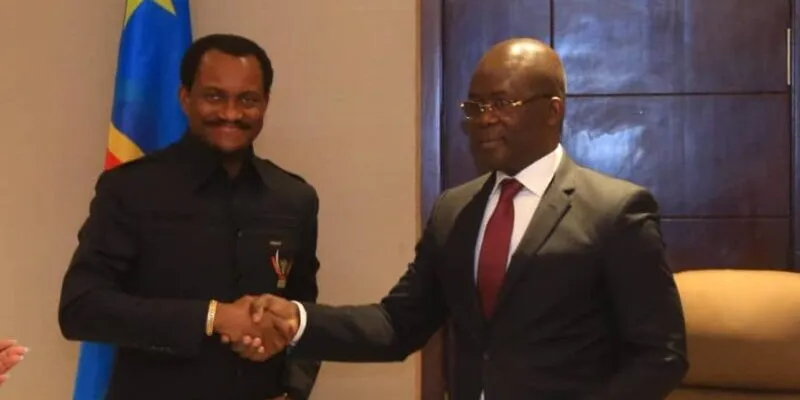
Jean-Lucien Bussa, the Democratic Republic of Congo’s Minister of Portfolio, and Miguel Kashal Katemb, Director General of the Autorité de Régulation de la Sous-traitance dans le secteur Privé (ARSP), signed a memorandum of understanding (MOU) on November 12, 2024, designed to improve coordination between state-owned enterprises and private companies engaged in dealings with the country’s vast state portfolio. The agreement, approved by the Council of Ministers in July, introduces a new framework for inter-company collaboration aimed at streamlining operations and leveraging resources more effectively.
A central pillar of the MOU is a preference system encouraging state-owned enterprises to prioritize internal transactions among themselves. In specific cases, the framework extends this prioritization to private companies involved in subcontracting work tied to the state portfolio. The initiative aims to enhance resource management and foster stronger relationships between public and private entities while bolstering the role of state-linked enterprises in key sectors of the economy.
The agreement also establishes a Joint Coordination Unit, a task force of experts drawn from the Ministry of Portfolio and ARSP. This unit will oversee consultations, set operational guidelines, and monitor the implementation of the framework. Minister Bussa emphasized the urgency of staffing the unit quickly, signaling the government’s desire to turn policy into action without delay.
Maitre Didier Kashala-Kamanda, Director of Operations at ARSP, noted that the MOU will also guide subcontracting activities toward enterprises connected to the state portfolio. By focusing on public-private partnerships (PPPs), the framework seeks to create a structured environment for knowledge-sharing between state-owned enterprises and private contractors, ultimately driving greater efficiency and cohesion in project execution.
the MOU is a broader effort to reimagine the role of state-owned enterprises in Congo’s economy, which remains heavily reliant on their contributions across industries ranging from mining to energy. While government officials describe the initiative as a step toward modernizing inter-company collaboration, its success will likely depend on the ability to overcome entrenched inefficiencies and ensure clear regulatory oversight.